Reactive Ink Digital Textile Printing: How to Get Vibrant Cotton Prints With a Proven Steaming and Washing Workflow
Reactive ink digital textile printing is the go-to production route when you print mainly natural fibers (especially cotton) and your customers demand deep color, clean detail, and strong wash performance. The tradeoff is simple: reactive delivers premium color on cotton, but only when you run the full steaming & washing workflow correctly.
If you’re already short-listing roll-to-roll systems, start with Fluxmall’s Direct Fabric Digital Printers catalog for production-class options and formats.
Why reactive ink digital textile printing is the “premium color” choice for cotton
Cotton reactive digital textile printing stands out because reactive dyes are designed to chemically bond with cellulose fibers, so color doesn’t just sit on the surface. That’s why reactive is widely used for cotton and other cellulose-based fabrics when brands care about color depth and wash durability.
In production terms, reactive is a strong fit when:
- You run cotton, viscose, linen, or blends that behave like cellulose.
- Your products require high color saturation and repeatable results batch-to-batch.
- You’re producing textiles that will be washed repeatedly (apparel, bedding, home textiles).
If you’re evaluating high-throughput roll printing, Fluxmall’s Textalk TK18 Series fabric printer is the best. It is positioned for proofing mass production use cases and highlights color performance and washing fastness expectations at scale.
Vibrant color on natural fibers
The reason teams choose reactive is straightforward: vibrant color on natural fibers is hard to beat with other chemistries when cotton is your core substrate. Reactive digital textile printing is commonly used where you need both color richness and a “true textile” look after finishing (not a heavy surface layer).
Typical high-value applications include:
- Fashion and cut-and-sew cotton (all-over prints, patterned fabric runs)
- Home textiles (bedding, curtains, upholstery-grade cotton blends)
- Scarves and lightweight woven goods where color depth matters
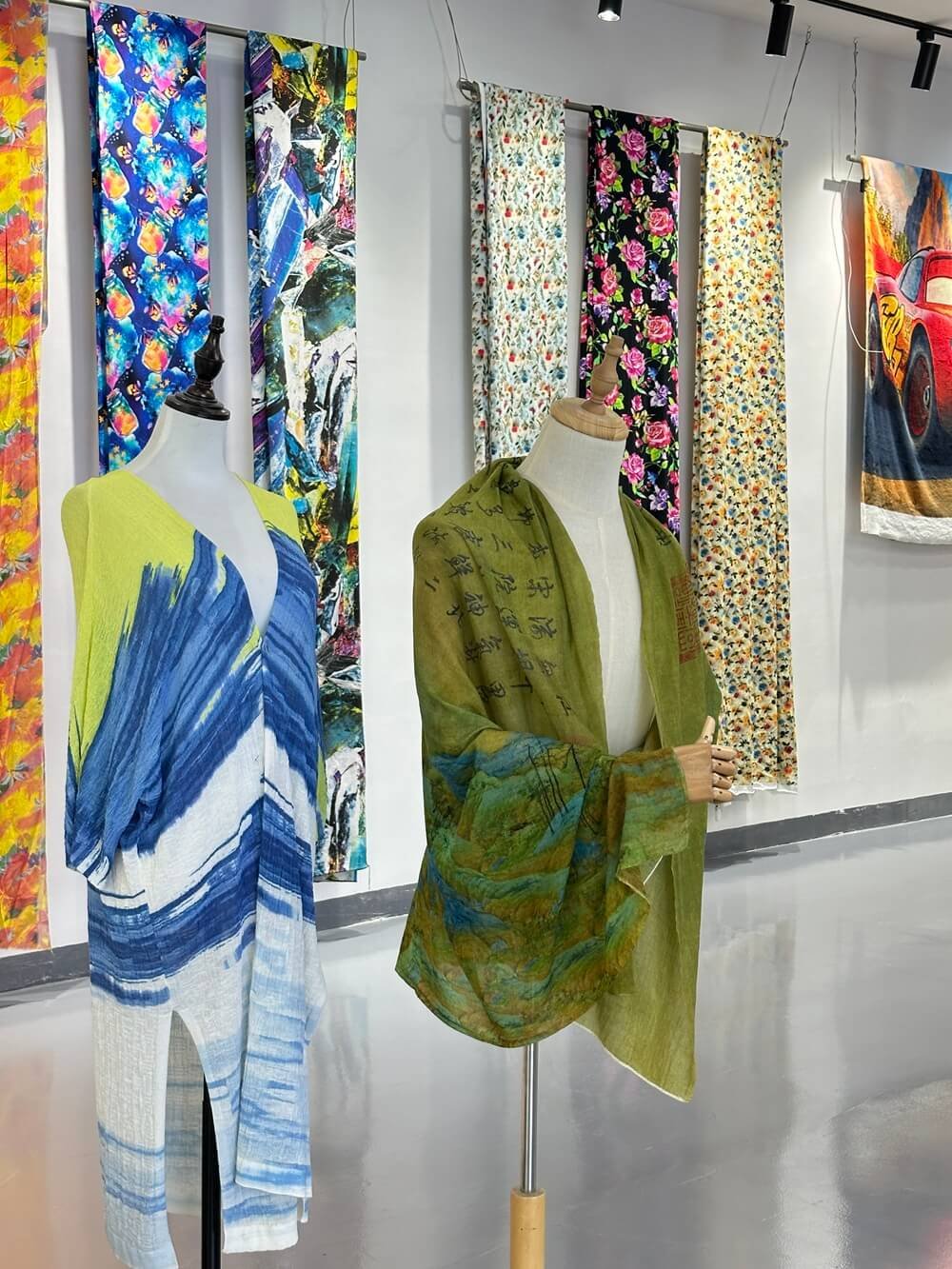
A practical expectation to set with stakeholders: reactive can be extremely impressive on cotton, but the result depends as much on fabric prep + fixation + wash-off discipline as it does on the printer.
Steaming & washing process: The production workflow you must plan
The reactive workflow is not just “print and done.” The standard process is pretreat fabric, print, steam to fix, wash to remove unfixed dye, dry, and finish. Steaming is used to fix reactive prints, and washing removes unfixed/hydrolyzed dye to improve fastness.
Here’s the workflow in a production-friendly checklist:
| Stage | What it’s for | What to control for consistency |
|---|---|---|
| Fabric pretreatment | Prepares fabric chemistry for bonding | Uniform prep, stable fabric moisture and storage |
| Printing | Lays down color accurately | Nozzle health, color management, consistent transport |
| Steaming | Drives dye-fiber reaction (fixation) | Time/temp/humidity consistency, loading discipline |
| Washing (wash-off) | Removes unfixed dye to prevent staining/crocking | Thoroughness and repeatability (often multiple wash steps) |
| Drying/finishing | Stabilizes hand feel and ready-to-ship fabric | Dryer capacity sized to match print output |
This is the critical production insight: your true capacity is the slowest finishing station, not the print carriage speed. If steaming or washing can’t keep up, you don’t have high throughput; you have WIP.
For capacity planning on the finishing side, Fluxmall’s Dryers category is a useful way to map what drying solutions look like around textile workflows.
Fixation: How to protect fastness
Fixation is where reactive digital textile printing wins or fails. Reactive dyes are valued because they can bond to cellulose, but the reaction is sensitive to process control during steaming and wash-off.
What to watch in real production:
Inconsistent fixation shows up as “great color out of the printer, disappointing results after finishing.”
If steaming conditions drift (time, temperature, humidity, loading density), fixation and shade stability drift with it.
Poor wash-off shows up as staining, crocking, or dulling after the first few washes.
Washing is not optional cleanup; it’s part of the quality outcome. The purpose is to remove unfixed dye so the textile meets fastness expectations.
Fabric preparation is the silent multiplier.
Reactive performance can look “random” when fabric lots vary (finishes, absorbency, storage humidity). The more you standardize incoming fabric specs and prep SOPs, the easier it is to keep color stable.
If your team needs a simple way to align technology choice with factory constraints (utilities, staffing, finishing capacity), Fluxmall’s guide on choosing the right printing method for your factory helps frame reactive vs pigment vs other routes as a system decision.
Reactive ink digital textile printing: How to choose the right system direction
When comparing a reactive ink digital textile printer, don’t start with the printer brochure. Start with your workflow reality:
1) Your fiber mix (especially cotton %)
Reactive is strongest when natural fibers are the main event, not a small add-on.
2) Your finishing commitment
If you can’t support steaming and wash-off at production scale, reactive will struggle to meet the quality promise consistently.
3) Your color control needs
For repeatable bulk output, plan for RIP discipline and profiling. Fluxmall’s neoStampa RIP overview is a good reference for production-minded RIP workflows and cost/color control:
4) Your scalability path
If you’re scaling into higher-volume roll production, evaluate platforms built for continuous output. For example, Fluxmall positions the Textalk TK20 Series Fabric Digital Printer as an industrial fabric printer for fashion/apparel production contexts.
Next step: Validate reactive on your real cotton and your real finishing line
Reactive looks amazing in perfect demos. What you need is proof it stays amazing in your operation: your cotton lots, your target shades, your finishing constraints, and your throughput targets. All of these, you can see on the demo of our digital textile printing lineup.
A productive next step is to book a session that focuses on end-to-end output (print → steam → wash → dry), not just print appearance. Contact us here to have a demo and receive more advice about this new technology.
Frequently Asked Questions
What is reactive ink digital textile printing?
Reactive ink digital textile printing is a textile printing method mainly used for natural fibers such as cotton, linen, viscose, rayon, silk, and bamboo fabrics. The reactive dye chemically bonds with the fabric fibers during fixation, helping produce vibrant colors, sharp detail, and excellent wash durability.
Which fabrics work best with reactive ink printing?
Reactive inks perform best on natural and cellulose-based fabrics, including cotton, organic cotton, linen, viscose, rayon, bamboo fabric, silk, etc. Cotton is the most common application because reactive inks provide strong color penetration and a soft hand feel on cotton textiles.
Is reactive ink printing suitable for polyester fabrics?
No. Reactive ink printing is not designed for polyester fabrics. Polyester usually requires dye sublimation printing or disperse ink technology instead. Reactive inks are optimized for natural fibers, while polyester printing requires heat-transfer-based dye processes.
Does reactive ink printing require fabric pretreatment?
Yes. Most reactive digital textile printing workflows require fabric pretreatment before printing. Pretreatment helps control ink absorption, color sharpness, penetration, and fixation performance. After printing, fabrics usually go through steaming, washing, and drying processes to achieve final durability and color quality.